
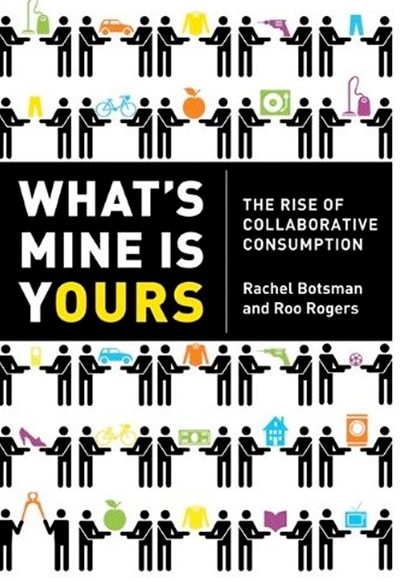
 Cognitive Surplus + Collaborative Consumption. Mix it up, stir it up, add a social agenda and what do you get? Good Times.
What we know is that someone born in 1960 has stared at the television set for roughly 50,000 hours. Yes, that’s right – this equates to over 5 and 1/2 solid years of passive T.V. consumption. Even more astounding as Clay Shirky explains, is that hijacking our time spent on this one-way viewing practice can, if we so choose, be leveraged as a social asset. “The buildup of this free time among the world’s educated population – maybe a trillion hours per year – is a new resource.”
Let’s not forget that Millennials are going to have careers that occupy 50,000 hours (ie. 25 years) as opposed to the 100,000 hours (ie. 50 years) of their parents. Compression of the traditional job has been occurring for sometime as organisations everywhere have learned how to make do with smaller bits of our time. As the futurist Charles Handy explains, CEOs know that, “Half the people paid double, working twice as hard and producing three times as much, has to be good sense.” We should acknowledge too that we are also living longer – if you are currently living in the UK you can expect to live 80+ odd years.
Cognitive Surplus + Collaborative Consumption. Mix it up, stir it up, add a social agenda and what do you get? Good Times.
What we know is that someone born in 1960 has stared at the television set for roughly 50,000 hours. Yes, that’s right – this equates to over 5 and 1/2 solid years of passive T.V. consumption. Even more astounding as Clay Shirky explains, is that hijacking our time spent on this one-way viewing practice can, if we so choose, be leveraged as a social asset. “The buildup of this free time among the world’s educated population – maybe a trillion hours per year – is a new resource.”
Let’s not forget that Millennials are going to have careers that occupy 50,000 hours (ie. 25 years) as opposed to the 100,000 hours (ie. 50 years) of their parents. Compression of the traditional job has been occurring for sometime as organisations everywhere have learned how to make do with smaller bits of our time. As the futurist Charles Handy explains, CEOs know that, “Half the people paid double, working twice as hard and producing three times as much, has to be good sense.” We should acknowledge too that we are also living longer – if you are currently living in the UK you can expect to live 80+ odd years.
What Happens Now?
Cognitive Surplus + Collaborative Consumption. Mix it up, stir it up, add a social agenda and what do you get?
Cognitive Surplus + Collaborative Consumption. Mix it up, stir it up, add a social agenda and what do you get? Good Times.
What we know is that someone born in 1960 has stared at the television set for roughly 50,000 hours. Yes, that’s right – this equates to over 5 and 1/2 solid years of passive T.V. consumption. Even more astounding as Clay Shirky explains, is that hijacking our time spent on this one-way viewing practice can, if we so choose, be leveraged as a social asset. “The buildup of this free time among the world’s educated population – maybe a trillion hours per year – is a new resource.”
Let’s not forget that Millennials are going to have careers that occupy 50,000 hours (ie. 25 years) as opposed to the 100,000 hours (ie. 50 years) of their parents. Compression of the traditional job has been occurring for sometime as organisations everywhere have learned how to make do with smaller bits of our time. As the futurist Charles Handy explains, CEOs know that, “Half the people paid double, working twice as hard and producing three times as much, has to be good sense.” We should acknowledge too that we are also living longer – if you are currently living in the UK you can expect to live 80+ odd years.